
From the Archive: The Places That Keep Kibworth Going — October 2026



A village is made by more than its houses, roads and shops. It is also made by the places where people meet, organise, celebrate, learn and spend time together.
For our October From the Archive feature, we picked three October editions to explore how Kibworth community buildings have changed, been repaired and remained in use across different generations.
We found three very different stories, but they share a common thread. People renovated, repaired or raised funds to keep important community places in use.
October 1988 — Issue 105
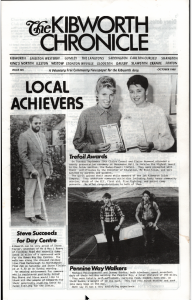
In October 1988, the Chronicle reported on major redecoration work at Kibworth Village Hall.
The hall had not seen major work for 17 years. The project involved much more than freshening up the walls. Workers tackled the main hall, committee room, kitchen, foyer, lavatories, cloakroom and storage areas. They also installed a new floor in the kitchen.
The article also looked back at the building’s history. The Victorian hall opened in 1866. The Chronicle described it as a handsome village hall with seating for 400 people.
The hall’s volunteer trustees carried out much of the physical work themselves. The renovation disrupted some regular activities, but the aim was clear. They wanted to put the building back into good order for the people who used it.
The article ended with a simple reminder: “Leave it as you would hope to find it!”
October 1989 — Issue 115
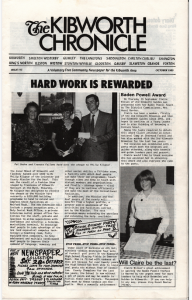
A year later, another familiar Kibworth landmark appeared in the Chronicle’s pages – the Windmill.
A young man from Kibworth had cycled to the mill to help put up its Christmas lights. He continued a tradition started by the late Brian Briggs. The illuminated sails created a giant Cross that people could see from the village during the twelve days of Christmas.
The previous year’s display could not go ahead because rotten timber had caused the top sail to break. By October 1989, workers had repaired the sails and the Christmas Cross could return.
The article also recorded something of the mill’s longer history. It had been given to the Society for the Protection of Ancient Buildings in the 1930s, helping to secure its future.
So the story was about more than Christmas lights. People had repaired a historic landmark and kept a village tradition alive.
October 2007 — Issue 295
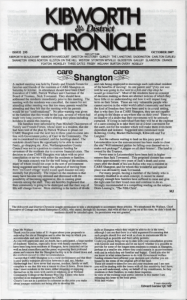
By October 2007, the Chronicle was reporting on another major building project, this time at Kibworth Methodist Church.
The church needed a new ceiling after 150 years. Subsidence had also affected a storeroom at the rear of the building. The church planned to demolish the storeroom and replace it.
Surveyors were preparing plans and a tender for the work. But the project presented an obvious challenge: major repairs would cost money.
Fundraising had already begun.
Ian and Gwyneth Varey offered to hold monthly coffee mornings. Stalls would sell bric-a-brac, cakes, toys, games, books and gifts. The organisers also sought donations. They planned the first coffee morning for 27 October.
Once again, the Chronicle recorded the practical side of maintaining a community building. The church had identified what needed to be done and started finding ways to raise the money.
Three buildings, three different challenges
In 1988, the Village Hall needed extensive redecoration after 17 years.
Then 1989, the Windmill needed sail repairs before an established Christmas tradition could return.
Finally 2007, the Methodist Church needed substantial structural work and a fundraising effort to help pay for it.
The buildings were different, and so were the challenges. But each story showed people taking action to keep an important place in use.
And that story has not ended.
The Windmill has since undergone another major restoration. Extensive work repaired the structure and returned it to working order. The Chronicle has continued to report on the mill and its open days. Volunteers still welcome visitors who want to see inside and learn about its history.
The Kibworth Harcourt Post Mill Open Weekend article published earlier this year is a reminder that the mill is more than a historic landmark. People still look after it and share it with the community.
The same principle applies elsewhere. The Village Hall remains an active community venue. The Methodist Church continues to serve the village. The Grammar School Hall and other community facilities have also entered new chapters as their uses, management and responsibilities have evolved.
The buildings change. Their uses change. The organisations responsible for them change.
But the need for places where people can meet, gather, learn, celebrate and organise remains.
Perhaps that is the real story in these three October editions. Keeping Kibworth community buildings going is rarely a one-off job. Each generation has to take it on for itself.
There’s more to discover in the archive
These three October editions are just a tiny part of the Chronicle’s back catalogue.
Since the first edition was published in 1978, its pages have recorded the people, organisations, businesses, events and changes that have shaped our local communities.
Explore the Chronicle’s back catalogue and see what else you can discover.
Mark Grech (Head of Archiving)