
From the Archive: Some Things Never Change



If you think arguments about new housing, traffic, parking and the changing shape of Kibworth are a modern phenomenon, the Chronicle’s back catalogue might make you think again.
For our first FROM THE ARCHIVE feature, we picked three September editions, 35 years apart, to see what they could tell us about Kibworth then — and Kibworth now.
What we found was a mixture of change, continuity and some remarkably familiar conversations about traffic, development and village life.
September 1986 — Issue 084
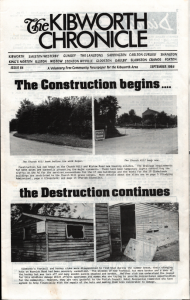
In September 1986, the big story was physical change. Construction had begun on new housing estates at Church Hill and Wistow Road, with drainage works already creating what the Chronicle described as major eyesores. Temporary traffic lights were controlling traffic on the A6 while services were installed, with work also taking place around the existing Church Hill grass verges.
It was not just the new houses that were changing the landscape. The issue also reported severe vandalism to the football and hockey changing huts on Warwick Road. Windows had been broken, a door torn off and wooden panels smashed. The Parish Council’s Joint Recreation Committee agreed to help with the repairs.
So, alongside the disruption of development, there was another familiar feature of village life: people trying to maintain the facilities and activities that brought the community together.
September 2007 — Issue 294
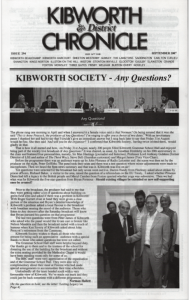
Move forward 21 years and the conversation had moved on — but not by as much as you might expect. Development, traffic, parking and pedestrian safety were still prominent local concerns. Parish Council discussions covered congestion, speeding, parking, road signs and measures intended to make roads safer, while construction continued to cause disruption around the village.
But Issue 294 also demonstrates how much of village life happens alongside those debates. The Great Kibworth Run was preparing to bring the community together, raising money for charity while also distributing grants to local organisations. Previous awards had supported youth groups, sporting organisations, Scouts, Guides, Brownies, the Primary Parents Association and other community groups.
There was clearly plenty to complain about — but also plenty to get involved in.
September 2021 — Issue 431
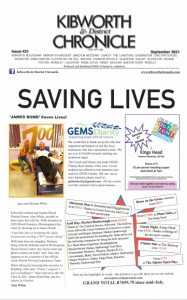
By September 2021, the scale of change was greater again. The Parish Council was consulting on a refreshed Neighbourhood Plan, considering proposals for 10 homes at St Wilfrid’s Close and supporting major improvements to the local recycling and household waste site.
Once again, development and infrastructure were being discussed alongside the practical realities of village life. But there was also a strong sense of community action. The Parish Council reported on activities involving local children, improvements to play areas and support for the Village Hall, while the wider Chronicle was recording communities finding their feet again after the disruption of lockdowns.
Even the cover tells its own story. Saving Lives highlights a community fundraising campaign involving local organisations — another reminder that when something matters, people in the area tend to get involved.
So, what has changed?
Quite a lot, of course. The houses are different. The population has grown. Businesses have come and gone. Technology has transformed the way we communicate, work and spend our leisure time.
But open three September editions from different points in the Chronicle’s history and a pattern begins to emerge.
People are still discussing development. They are still concerned about traffic, roads, parking and infrastructure. They are still organising events, supporting local groups, raising money, playing sport and looking after the places they share.
Perhaps that is the real story. The village changes. The technology changes. The problems change.
But the fact that people care enough to get involved does not seem to change very much at all.
There’s more to discover in the archive
These three September editions are just a tiny part of the Chronicle’s back catalogue. Since the first edition was published in 1978, its pages have recorded the people, organisations, businesses, events and changes that have shaped our local communities.
Explore the Chronicle’s back catalogue and see what else you can discover.
Mark Grech (Head of Archiving)
 Are you interested in an allotment?