
East Langton and the John Logan connection


Our plea for Kibworth & District Chronicle deliverers for East Langton has been successful with three people stepping forward. Thank you to those who have volunteered.
With this in mind we print below part of Len Holden’s long article from The Harborough Historian.
East Langton and the John Logan connection
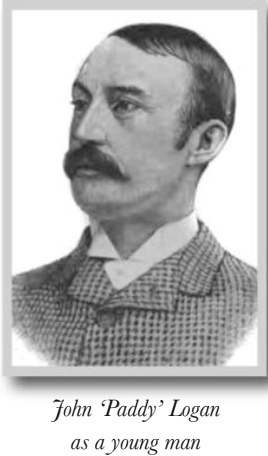
John Logan was born in 1845 in a large house in Maindee Park, Newport. His father, also John Logan, was partner in a firm of construction engineers which built Newport Dock and other projects. He was thus from a well off family and was educated at The Collegiate School, Gloucester. After he finished he was articled to Messrs Stevenson, Mechanical Engineers in Newcastle, becoming an Associate Member of the Institute of Civil Engineers. In 1874 he married Maud Ansdall, daughter of Reverend B.E. Watkins of Rotherham. They had three sons and six daughters.
In 1875 he moved to East Langton Grange, where he virtually became ‘Lord of the manor’ in all but name. He was to later to build a number of properties there for his children.
Professional Career
He was a man of great energy and vision. He rapidly rose to become head of the firm Logan & Hemingway, Engineers and Railway Contractors. By 1897 he was a very large employer in Leicestershire and other Midland Counties. Logan and Hemingway also carried out a number of contracts building fish docks in Manchester. And also a long stretch of the Great Central Line from Sheffield to London. In 1874 the company constructed The Great Northern Railway Line from Market Harborough through Medbourne to Leicester. They also built stations from Arkwright Street, Nottingham to East Leake.
John was a successful businessman and amassed a considerable wealth. He was a natural leader and highly respected by his workforce. He was greatly concerned with the welfare of the navvies. On their arrival at the construction site each newly recruited navvy was given a barrow and £1 by Mr. Logan.
The Times obituary said of him ‘He was a strong man physically and quite capable of dealing with a recalcitrant navvy with his fists.’ On one occasion he had a fight with a labourer and lost decisively – whereupon he gave the man a pound note!
“Paddy“
This concern about the lives and conditions of the men formed the basis of his celebrated name ‘Paddy’. Many of the men who worked on the railway and other heavy civil engineering projects were from Ireland. They were a hard drinking and fighting bunch but ‘Paddy’ appreciated their rough ways and respected them as workers. He of course, was not Irish at all, but Welsh born with a Scottish father.
He often defended his Irish navvies against the prejudices of local people and the press and this was why the name ‘Paddy’ was bestowed on him. From being a term of abuse initially it soon evolved into a term of endearment.
Fair Pay for Workers
He believed in a fair society in which the working man was paid a decent wage. He advocated holidays with pay and Saturday half day holidays for farm labourers. His own employees were well treated and rates of pay were well above district rates of pay, which angered local employers, for example farmers, who paid their workers much less.
The farm labourers of course did not appreciate being paid less than the navvies and on one occasion they set fire to a farmer’s house in Medbourne as a protest. On his death all his employees received annuities.
An article in 1892 in The Wyvern, a Leicester Journal stated:
‘Although John Logan usually employs hundreds of men he has never yet had to advertise for navvies and that is more than any other large firm of contractors in the Kingdom can say. There is probably not a man who has worked for Mr. Logan for any length of time who does not speak of him in the highest terms.’
The article continues by stating that during the winter of 1890-91, when there was nine weeks continuous frost, making railway building impossible, Logan and Hemingway’s men still received full wages.
Home for Children
At East Langton he built a home for children whose parents had been killed or permanently disabled in railway or dock construction accidents. It took six girls and six boys between the ages of three and fifteen years. He took a great interest in local community life and he served as a Justice of the Peace for 40 years becoming Chairman of Market Harborough Petty Sessions, he was a member of Harborough Board of Guardians which oversaw the Work House and was also a member of the District Council Sanitary and Highways Committees.
East Langton
In East Langton where he lived, he provided a village hall at his own expense – said to be one of the finest in the country. He also had a cricket field laid out.
The whole village was really his ‘Estate Village’ and some of the cottages he built were named after members of his family: Isabel Cottage, May Cottage, Ida Cottage, Ruth Cottage and Colin House (named after the son who died in infancy). He had an elaborate system of pumping water to the Grange Water Tower and even his own Fire Engine.
There is so much more to John Logan’s life. Please read Len Holden’s article in full – The Life and Times of John ‘Paddy Logan (www.marketharboroughhistoricalsociety.org/ – Issue 39, October 2022) where you will discover John Logan the politician, the benefactor of Logan Street Recreation Park in Market Harborough, his views on Irish Home Rule and agricultural labourers, the Fernie Hunt (a passion), his suffragette daughters and racing pigeons!