Walking around Kibworth it was noted that there is a blue plaque on the former doctor’s surgery on Smeeton Road celebrating John Kenney. It was John who illustrated Thomas the Tank Engine books along with work for the Loughborough-based Ladybird Books.
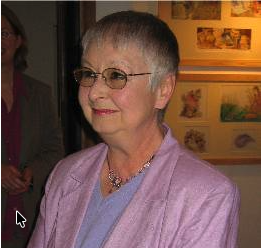
Former Kibworth resident Kathie Layfield (she lived at St Arvans on Fleckney Road) also illustrated numerous Ladybird Books and undertook private art lessons once she retired.
Should there be a plaque for Kathie?
Kathie Layfield, an illustrator for Ladybird Books from 1976 to 1988, collaborated on various series like ‘Well Loved Tales’, ‘Children’s Classics’, ‘Learnabout’, and ‘Read It Yourself’.
Born in Bristol on April 2, 1940, Layfield moved to Burton on Trent in 1948. She studied at Girls’ High School and Loughborough College of Art, earning an NDD in Printed Textiles and a Diploma.
Later, she attended Leicester College of Art, obtaining an art teacher’s diploma and teaching art in Leicestershire schools and colleges. She also acted, designed sets, costumes, and publicity for ‘Leicester Drama Society’ and participated in the ‘Leicestershire Youth Theatre’ movement.
Kathie’s passion for painting, especially illustrative work, led her to pursue her art despite teaching full-time. She exhibited in various shows, including a solo exhibition at the ‘Little Theatre’, Leicester.
An art director at ‘Ladybird’ saw her costume designs and asked if she’d interested in illustration. They were struggling to find artists who could paint figures, so he asked her to bring some of her work.
Her work was approved, and she was given a trial commission, which resulted in her illustrations being published in ‘Action Rhymes and Memory Rhymes’. From those first books, she received a series of further commissions.
She spoke of her work and its highs and lows.
Working for Ladybird Books
“For each book, I received a paste-up with the text in a mock-up, with gaps for illustrations. I drew rough visuals to fit the text and could move the text around if it suited my ideas, but I rarely did this. I submitted the visuals, and any changes were noted before I started painting.
I had no trouble coming up with suitable ideas. My imagination and acting experience helped me interpret characters and expressions. I often used humour in my illustrations and included a running gag for children to discover hidden in the books.
‘Ladybird Books’ had some control over the final product, but I had a lot of creative freedom. I could choose my style and format, though the size and shape of the book were determined by the firm.
I worked on strippable board to remove illustrations for printing, which were then returned to the boards and stored. I only received them again when the firm closed.
I liaised with two art editors and occasionally the editorial staff. I only contacted authors later when negotiating public lending rights.
Presenting my finished work to the editors was always nerve-wracking, but I usually only had a few corrections.
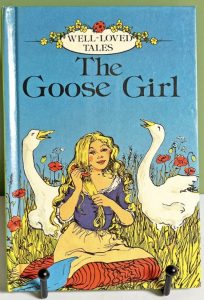
‘The Goose Girl’ was an exception; I struggled with it, possibly because I didn’t like the story. I couldn’t understand how a macabre, cruel, and miserable tale would appeal to children, but perhaps that’s Hans Andersen’s genius!
Completing each book took me about two and a half months. As a full-time teacher, I worked in my spare time, so I was fast and met deadlines, unlike full-time illustrators.
I rarely had a difficult schedule and loved the work, so I gave it my undivided attention. Sometimes, I forgot to eat!”
What was my favourite Ladybird Book?
“Choosing a favourite book is challenging. I enjoyed researching costumes and details in ‘The Railway Children’, but I avoided too many train references.
I’d love to redo some books, like the ‘Learnabout Drawing and Painting’ books I illustrated and co-wrote. I could write about something I knew well and choose my illustrations, but sadly, I never got the chance.
‘The Goose Girl’ gave me a headache, and ‘The Ladybird Book of Puzzles’ was the other book I least enjoyed. The drawing was factual, so I couldn’t use my imagination.
I couldn’t draw a bike, so someone in the studio drew it for me.
My memories of working with ‘Ladybird’ are happy. The people I dealt with were always helpful, reassuring, and friendly.
I was treated well and often invited to attend book fairs to demonstrate illustration or draw portraits of children. My ‘Ladybird’ years were the happiest and most fulfilling of my life.
I was paid promptly for each picture I illustrated, which is unusual for publishing companies. I signed a contract before accepting the commission.
‘Ladybird’ paid a non-negotiable fee without royalties. I was sorry about this, knowing their large turnover.
I illustrated about 30 books and three videos, plus several promotional illustrations.
My work ended when the Loughborough-based company closed. Despite asking for new work, I was told there wasn’t any.
I had always been in work, had never missed a deadline, and had recently illustrated books that had been accepted for printing. I couldn’t understand why there was no one left on the staff that I knew.
The new art director treated me as if I was a stranger, asking me to do trial pieces despite my published work. It was a sad and humiliating end.
I miss the work.
I still give talks about my books, and I have original pictures to show. I’ve sold paintings to private collectors, auctioned some at ‘Bonhams’, and ‘Charnwood Museum’ bought a large collection after my solo exhibition in 2004.”
Kathie, a long-time member of the Leicester Society of Artists, passed away in 2022.


 Chronicle distribution volunteers needed