
Nature Notes – Make the Most of Spring


Between now and July, your garden, favourite park or nature reserve will be alive with fauna. These may have returned from warmer climes, emerged from hibernation, or hatched from pupae. Resident species will have become more active, ready to raise a new generation.
It is perfectly acceptable to enjoy the dawn chorus, the buzz of insects or the vibrant colours around us. However if you like to put a name to what you see or hear, spring is full of challenges. Armed with binoculars, field guides and smartphones, identification is potentially getting easier. However, nothing beats time and patience when dealing with tricky pairs of species. I am listing just a few such challenges starting with some that are easier to sort out, then moving to some that are more difficult.
Carrion Crow or Rook? Now is the time to get familiar with the calls of these two large ‘corvids’. Rooks nest colonially (rookeries). Most villages have a rookery (Kibworth has at least one, near the A6 roundabout at the northern end). Birds are very vocal around these nests; calls are a single, long “raak”. Carrion Crow pairs on the other hand build a large nest high up in trees away from other birds. These nests are easiest to see before trees are fully in leaf. Crows flying to or from the nest often call; three or four repeated notes “caw, caw, caw”. Individual birds flying over are often best identified from their call.
Buzzard or Red Kite? We see both of these quite frequently and Red Kites especially fly close enough to show the red, forked tail, pale head and overall rufous plumage. Both birds call frequently. Try to hear both the Buzzards “mew” call as it soars lazily overhead and the Kite’s more urgent “squealing”.
Blackbird or Song Thrush? Adult birds are easy to tell apart given good views although somewhat spotty-breasted juvenile Blackbirds are occasionally confused with Song Thrush. These two species make loud contributions to the dawn chorus. The easier of the two to identify is the Song Thrush. It can produce a wide variety of song phrases but helpfully it almost invariably repeats phrases of songs three or four times before moving onto a new phrase. Blackbirds on the other hand sing strongly both morning and especially during the overall quieter evening chorus. Mainly, mellow, sweet-sounding notes, sometimes rambling and without the obvious repeated phrases of the Song Thrush.
For more difficult challenges, try separating the songs of Blackcap and Garden Warbler in woodland or scrub and Reed Warbler and Sedge Warbler in wetter habitats. Try to actually watch a singing bird. You may need your field guide and/or favourite App to get to learn which song is which.
Insects being smaller and more numerous provide far more difficult identification challenges. Bee, Wasp or Hoverfly? There are many species to find in every garden. A good starting point is becoming familiar with honey bee, bumblebees, hoverflies and wasps. Some key features include: bees and wasps have two pairs of wings, hoverflies just one pair. Most wasp species have very ‘pinched’ waists, while bumblebees are generally fatter and more hairy than honey bees. Several species of bumblebee are likely to visit your garden. They particularly like single, open flowers rather than the complex doubles that might look appealing in the seed catalogue. Helpfully most seed manufacturers indicate plants that are pollinator friendly.
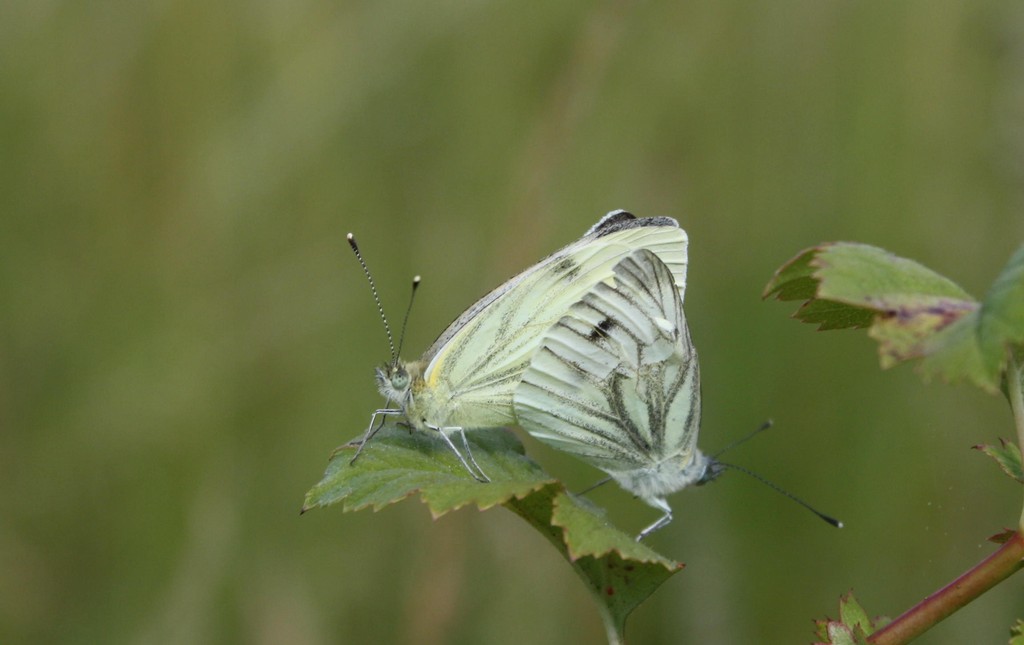
“White” Butterflies. Orange Tip and Green-veined White are two of the earlier butterflies to emerge. Male Orange Tips are readily identifiable but the females don’t have orange wing-tips so the marbled pattern on the underwing needs to be seen and compared with the dark green lines on the Green-veined White. Later in the summer, Small and Large White butterflies present a more difficult challenge, so familiarity with Green-veined will help you then. This month’s photograph is a pair of mating Green-Veined Whites, female on the left.
Whatever else you do; enjoy the abundance of new life this spring.
David Scott
 Dear Editor