
Nature Notes – February 2026


Miniature star of “House of Games”
You may be familiar with Richard Osman’s ‘House of Games’. In one round contestants have to write down estimates of things that they are unlikely to be familiar with. Recently the question was: How many Short-tailed Field Voles (commonly called just field voles) are there in the UK?
How many??
I know that many birds, carnivorous mammals and snakes incorporate field voles into their diet. This suggested to me that there would be quite a lot of these rodents in the UK. My blind guess of 20 million exceeded the guesses of the contestants but was woefully short of the actual estimate from the Wildlife Trust which is 75 million, roughly the same as the human population of the UK.
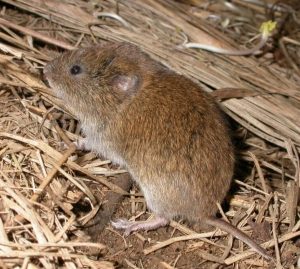
Common but rarely seen
Even if you spend a lot of time outdoors you may never have seen this small rodent. It may reveal itself with a squeak from deep vegetation or by be seen dashing across a path into cover. Even then how easy is it to decide which small mammal you just encountered? I haven’t seen many but it is likely that a good proportion of the mammals that I see being carried by owls, and kestrels, are this species. These specialist hunters have exceptional hearing, and/or sight good enough to detect even tiny displacement of vegetation. Field voles are very incontinent and kestrels in particular can detect them by recognising traces of urine in the vegetation.
Any estimate of so secretive a species is likely to be very approximate. More so in a species that can have up to six broods totalling 30 or more young in a year. The population varies considerably within the year dependent on whether the birth rate and predation rate are in sync. Consequently, field voles, like their European cousins, lemmings, experience population explosions and crashes, depending on weather and food availability.
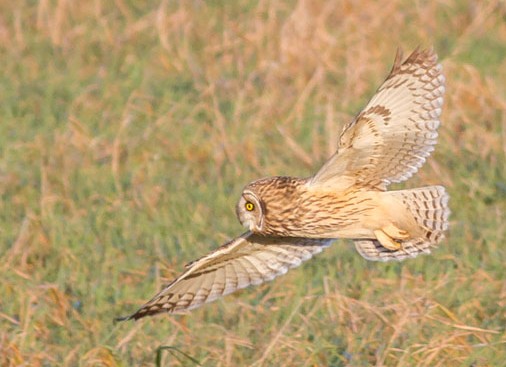
But often caught!
When owl pellets are examined it is not unusual to find the bones and fur of more than one vole in a single pellet. These are very small mammals weighing on average only 30 grammes. Any raptor, weasel or fox that hunts field voles to feed their young will need to catch a large number of voles in as short space of time.
There are almost certainly some of these rodents living near to you. They like rough grassland, including both wet and dry areas. Roadside verges are often a suitable location which is one of the reasons that motorists often see hovering kestrels by day or hunting barn owls at night. Voles tend to live in shallow “runs” close to the surface or in very deep grass in a network of tunnels burrowed through the base of vegetation.
One winter some years ago, up to five Short-eared Owls were found hunting over a grassy field near Hallaton. People who walked into the field reported that it was riddled with runs through the vegetation and small holes to underground tunnels.
In the main, field voles are not a pest species. In years of peak populations they can damage growing crops but in the main they live in rough vegetation along the boundaries of fields or in areas set aside for pollinators and other wildlife.
David Scott
 Matter of letters