
Nature Notes – Jan 2026


Listening for ‘Lesser Spotteds’
If you are a regular watcher of wildlife programmes, you will be familiar with “trail cams”. These are small cameras attached to a tree or post that are triggered by movement. They capture images of shy and nocturnal mammals moving along forest trails, often at night.
Listening for birdsong
Trying to find rare songbirds in dense woodland can now be assisted by the “aural” equivalent of the trail camera – a passive acoustic monitor. These are set to record from before sunrise each day and moved around the forest every few days. An observer moving slowly through the wood might pick up some songs and calls. But they may miss intermittent song and calls hidden within a noisy dawn chorus or background traffic noise. Recordings made over an extended time and analysed using artificial intelligence can detect more sounds. It can be programmed to weed out similar calls and songs of other species and the noises of the forest, caused for instance by the movement of branches in a breeze.
Lesser Spotted Woodpeckers
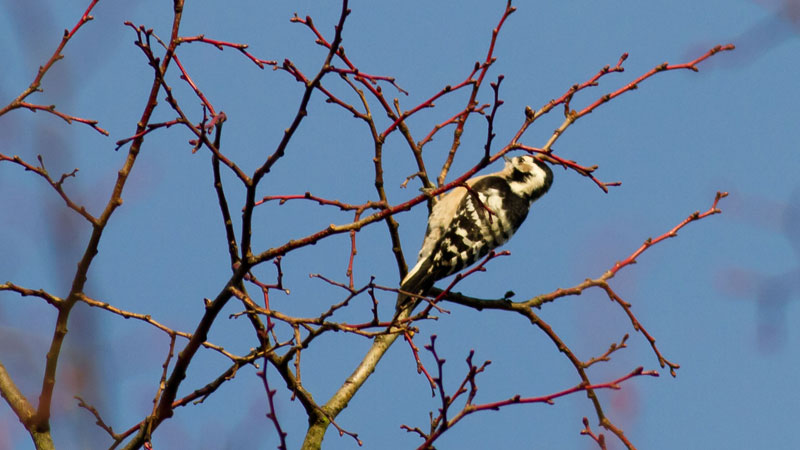
An article in the December edition of British Birds magazine described how the population of Lesser Spotted Woodpeckers is being monitored in the New Forest. This species is a rapidly declining species in the UK. Its “song” is drumming of its beak on the trunk or branch of a tree, and it has a high pitched call. These are not too dissimilar to those of its larger relative, the Great Spotted Woodpecker. They can be separated by experienced birders. AI (Artificial Intelligence) and the sonograms that it produces are potentially more reliable.
The New Forest trial made a number of interesting discoveries and helped to refine the AI programme. Successful males “drummed” for a relatively short period in March and April. However unpaired males continued drumming into May and June. Drumming and calling were often for a short time period and often early in the morning. Perhaps most encouragingly; the population in the study area was greater than previously thought. This included birds in areas of the forest not previously thought to hold this species. The methodology has now been used in other southern counties with known Lesser Spotted population, and new territories are being found in these areas too.
You might ask what have woodpeckers in the New Forest to do with Kibworth?
The answer is that twenty years ago it was possible to walk the canal towpath between Wistow and Fleckney in late March or April and expect to find all three British woodpeckers in a morning. Sadly there now seem to be no Lesser Spotted Woodpeckers in Leicestershire or Rutland. Other elusive species such as Willow Tit, Tree Sparrow, Turtle Dove and Nightingale are at best hanging on by a “wing-tip”.
The next comprehensive survey of British bird populations will be undertaken between 2028 and 2031. By then it may be possible to use acoustic monitors more widely. This will enhance our knowledge of populations of shy woodland species.
David Scott
 Leicestershire Parkinson’s Choir